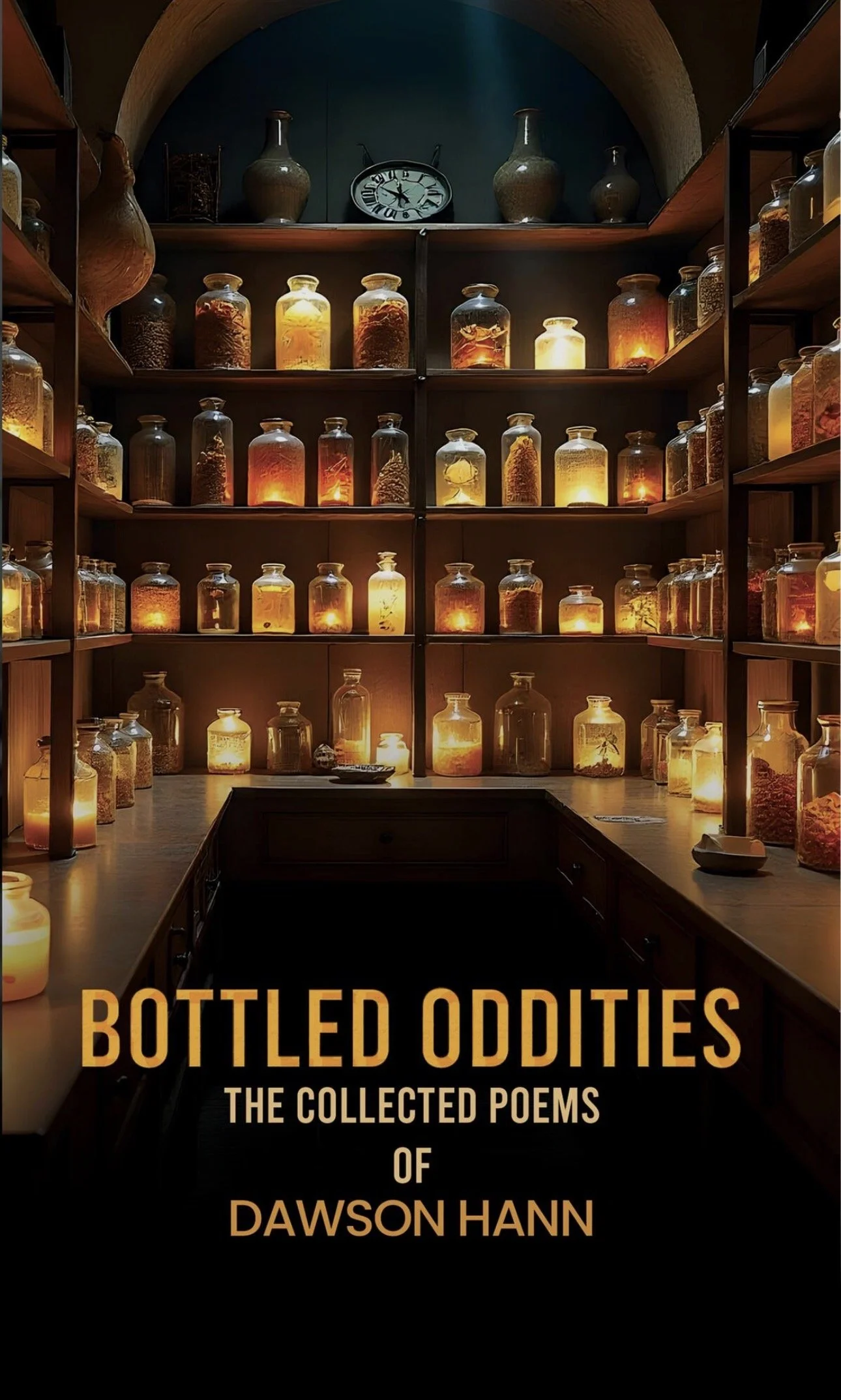
Dawson Hann has spent a lifetime noticing what others pass by: a phrase used awkwardly, graffiti carved into a school desk, the disappearance of Adelaide’s trams, a tie presented for service to school sport. He takes these small things down from the shelf, turns them in his hands, and asks what they might contain. Sometimes the answer is a joke. More often, the joke opens onto something tender or unsettling.
I have known Dawson for more than forty years, variously as teacher, football coach, theatre director and friend. His voice is unmistakable in Bottled Oddities, though the poems reveal dimensions of a life that even long acquaintance cannot fully disclose. A poem can be a surprisingly candid form of conversation, even from a man who does not always volunteer his confidences.
The title suits the collection. Dawson grew up in Adelaide, travelled widely, lived and worked in America, and served in the era of the Vietnam War. He has loved sport as deeply as he has loved the arts. Those experiences give the poems their reach, from an Australian beach to the ruins of My Son in Vietnam, from a Melbourne bar to an American autumn shadowed by September 11. But he is just as interested in the history held inside an ordinary life: what disappears from a city, what a person keeps from childhood, and what we owe one another while there is still time to say it.
In “Adelaide Trams”, the old routes carry him back towards the edge of the world as he once knew it. The poem is about the trams, certainly, but also about the peculiar loneliness of remembering something vividly when the people around you cannot picture it at all. “Du Temps Perdu” finds a similar force in the chutneys, bottled fruit and jars of an earlier domestic world. Dawson understands that memory often resides in objects too humble to be preserved anywhere else.
His humour is unmistakable. “A Grammatical Turn” worries an awkward sentence as only a lifelong teacher of English could. “A Confirmation of Darwinism” gives the avocado an absurdly anxious inner life. “The Cultural Collusion of Flies” makes a visiting American’s encounter with Australian insects into a sly little study of national character. Dawson enjoys language, including its capacity to misbehave. His wit is crisp, sometimes bawdy, and seldom interested in being polite merely for the sake of it.
Then a poem changes the light in the room. “Another Year of Lost Children” begins with a teacher being asked how many lives he has ruined that year. The question is delivered with a smile, but Dawson refuses to let it remain a joke. He turns towards the student whose work was dismissed, the child whose audition was cut short, the harm an adult can do in a moment of impatience. Its self-scrutiny is the mark of someone who understood that teaching carries power, and that power requires care.
Wesley College was Dawson’s working life for more than forty years. Generations of students knew him in classrooms, on playing fields and in theatres. He wanted them to read closely and think clearly, to commit themselves to a game and to risk themselves on a stage. He did not see those as competing ambitions. They were ways of becoming more fully alive.
“The Moving Finger”, prompted by a tie given for service to school sport, offers a wry view of recognition: the years of work, the public ceremony, and the human wish to hear one’s name spoken. “Graffiti” finds a student’s anonymous question carved into a desk and pauses over the person who left it there. In both poems, Dawson is alert to the small distances between what institutions celebrate and what an individual feels.
His attention extends well beyond school. In “Stretcher-Bearers: World War One”, the men carrying the wounded bear the weight of lives that might have been lived. “The Falling Man” confronts one of the most terrible images of September 11 without allowing its familiarity to make it less human. These poems do not claim that history can be made neat or comprehensible. They insist that we look closely at the people within it.
Ageing lends the collection some of its deepest notes. “A Poem of the Unpoetic” meets bodily indignity with the sort of candour that still finds room for a laugh. “Monument Man” imagines the diminished world of an older man in care, and his desire to remain a person with music and thoughts of his own. In “Ebbing”, a friend’s remark about growing old is left partly unresolved. Dawson lets us sit with what cannot be easily answered.
Dawson has little patience for a world in which every spare moment must be filled by a screen. “Mobile Phonies” makes that plain. He would, one suspects, have even less patience with the notion that a machine might substitute for the work of reading, making or imagining. “Reading” reminds us of the physical pleasure of opening a book and the larger freedom found within it. Across these poems runs a belief that literature, theatre and art help us notice lives beyond our own.
Bottled Oddities is funny, sharp, occasionally indignant and often quietly sorrowful. Its voice is exact in its observations, impatient with cant, and more tender than its author might care to admit. Dawson asks us to look again at the familiar world: at its absurdities, its losses, and the people whose lives touch our own.