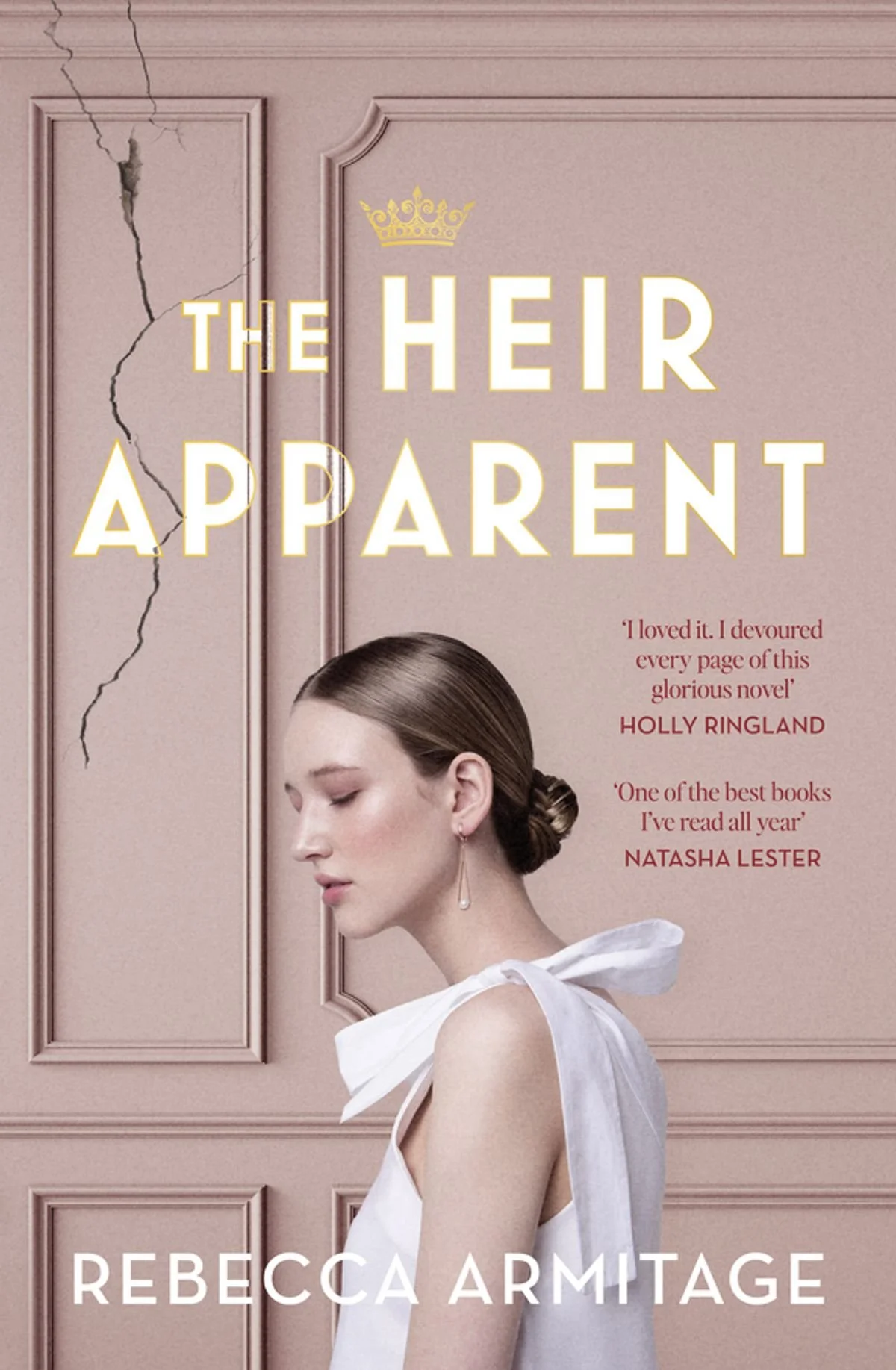
Rebecca Armitage's The Heir Apparent is a royal flush down the dunny of aristocratic absurdity…or is it?
There are two possibilities. Rebecca Armitage has written a savage satire of the British monarchy, or she has written an entirely sincere account of people so spectacularly useless that satire has become unnecessary.
I hope it is satire.
Princess Alexandrina, or Lexi to those permitted within hereditary striking distance, has sensibly escaped to Tasmania, where she practises medicine among people capable of speaking to one another without consulting a seating plan. Then an avalanche kills her father and twin brother, probably mercifully, and she is dragged back into the gilded mausoleum of British royalty.
The throne is occupied by an ageing Queen from House Villiers: a thinly disguised Saxe-Coburg-Gotha-Windsor substitute. Lose the Germanic emotional constipation and gain Gallic insouciance. But otherwise, like the actual royals, the family has pretty much lost its original purpose and has long since died of embarrassment. Around them, aristos curtsey, calculate rank and treat ordinary human feeling as a constitutional crisis.
Enter Vicki Shankar, nouveau riche interloper into this world, who manoeuvres her unwitting and protesting children into a prep school for Bordeaux-swilling woke-types and the progeny of movie stars to cultivate royal friendships: a magnificent portrait of ambition reduced to proximity.
The closer these people get to royalty, the less human they become. Contrast that to Lexi’s antipodean work colleagues. In Hobart, Lexi is treated as a person. In England, she is treated as an asset, an inconvenience or a ceremonial object. Affection is conditional, loyalty transactional.
I listened to The Heir Apparent via audiobook. Narrating legend Shakira Shute lets us have every Sloane Ranger inflection with both barrels; that is, when she is not forcing the narrative via her nostrils to give Lexi’s Hobart push a bit of Aussie authenticity. But back in Blighty, the lilting aristocratic inanities make the entire production sound like an extended Monty Python sketch. I could not decide whether the narrator was parodying the British upper class or merely reproducing it. Either possibility is alarming.
La Maison de Villiers, of course has its secrets: twin brother Louis sexuality, there’s a marriage a family lawyer was not needed to determine as decidedly iffy, and an Uncle Richard, who disgraces himself in ways only an uncle can, all exposing an institution so obsessed with appearances that truth has become its only unforgivable offence.
Lexi ultimately renounces the inheritance, exposes the secrets and returns to Tasmania. Shades of Edward VIII minus the Nazi connections. Sensible woman.
If this is intended as satire, it is gloriously vicious.
God save the Queen.
From this novel.