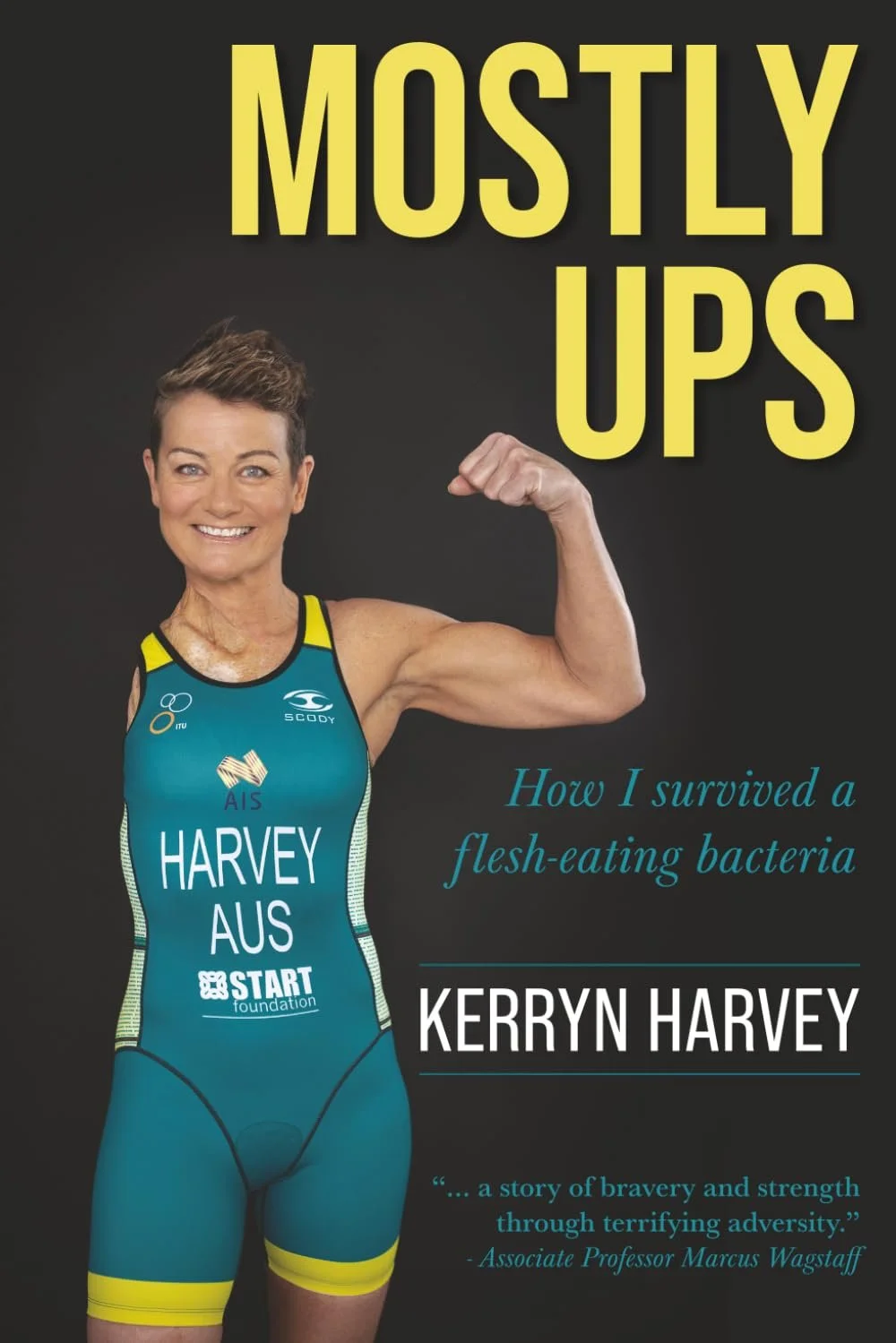
Kerryn Harvey has proudly worn the green and gold representing Australia as a para-triathlete. But it is perhaps through her writing that she most wonderfully represents the Australian character. There is the self-deprecating humour, the willingness to be silly, the reliance on mates, and that peculiarly Australian capacity to find something funny even when circumstances suggest there is nothing to laugh about.
In 2013, following a seemingly minor cycling accident, she contracted a flesh-eating bacterial infection that nearly killed her. Multiple organ failure, repeated surgeries, extensive skin grafting and the amputation of her entire right arm and shoulder followed. What makes Mostly Ups so engaging, however, is both the enormity of Kerryn’s ordeal, and the wonderfully ordinary details of learning to live afterwards.
How do you butter bread with one arm? Tie your shoelaces? And why, in a world apparently capable of producing every conceivable variation of women’s underwear, can nobody manufacture a bra for a woman with two breasts but only one shoulder?
These are the moments that give the book its humanity. There is nothing grandiose about Kerryn’s account. Her prose is direct, conversational and refreshingly unpretentious. She tells her story as though sharing it with a friend, frequently finding humour where another writer might have sought sympathy.
There is, of course, something extraordinary about the human spirit and its capacity to sustain the body through seemingly insurmountable adversity. Kerryn’s fitness, determination and sheer refusal to surrender undoubtedly played important roles in her survival and recovery.
But it is the title that captures the book’s essential wisdom. Mostly Ups does not pretend there are no downs. There are plenty: pain, grief, loneliness, frustration and the daily indignities of a body that no longer works as it once did. The point is not to deny them. It is to refuse to let them define the whole of one’s existence. Kerryn’s story is remarkable, but her telling of it is delightfully human. There is courage here, certainly, but also friendship, absurdity, laughter and an infectious appetite for life.
And that, perhaps, is what makes it such a wonderfully Australian memoir.