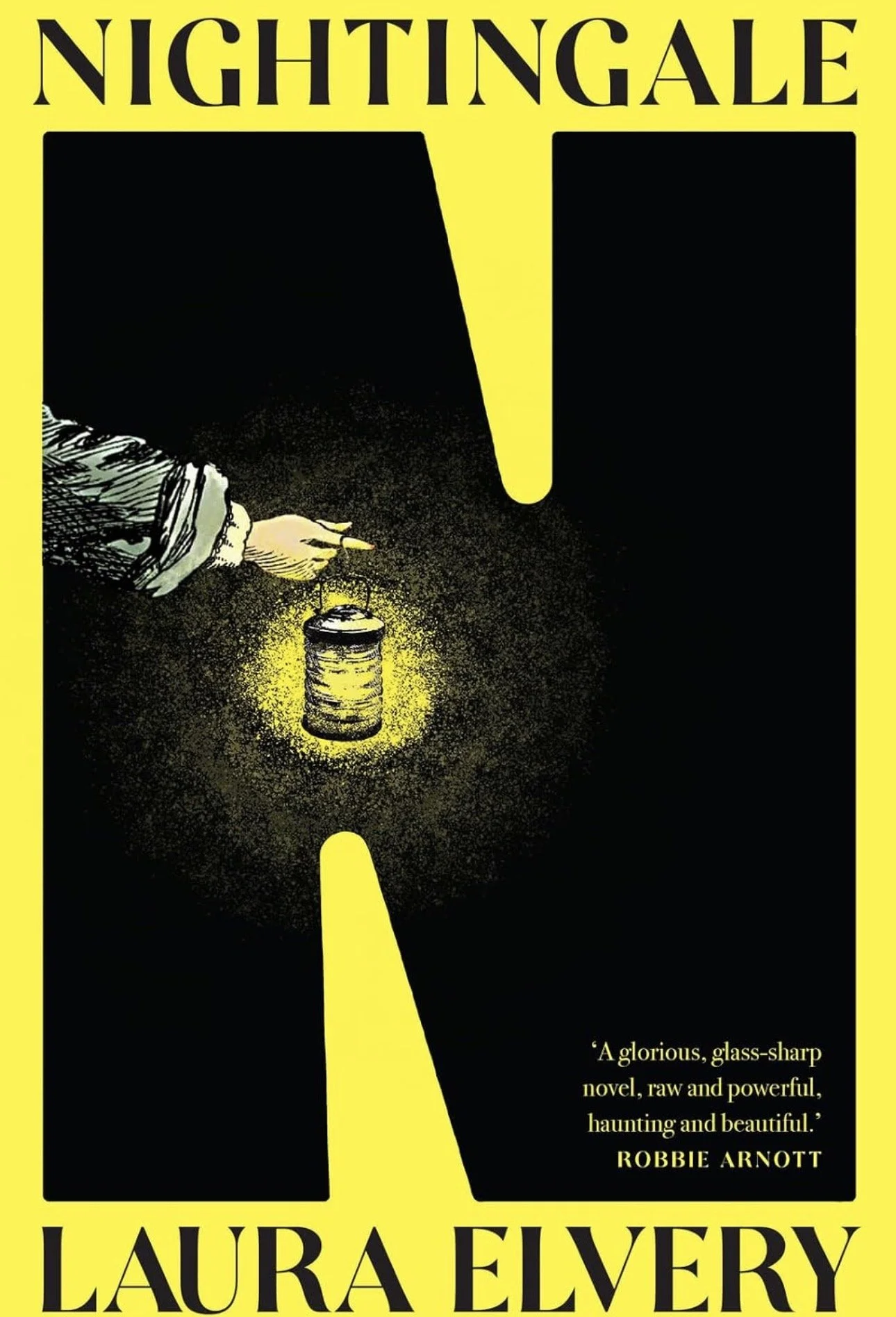
Nightingale. by Laura Elvery is a beautifully written insight into the humanity of its central character, not the legend. Three stanzas and perspectives drive the narrative. There is Florence in her final months, haunted by the ghosts of soldiers she has cared for, who appear either dream-like, or as part of her inevitable dementia. There is Silas, a ghost, who has come to Florence to seek an explanation for his circumstances. And there is Jean, a nurse in Florence’s command, who fell in love with Silas and intervened in his final moments. Alongside the three perspectives are the book’s three carefully constructed stanzas.
In the first, there is an almost pious restraint to the writing, as if revealing the characters’ religious convictions through their own reflections. There is a distinctive, if occasionally monotonous (to modern eyes), beauty. We follow the recruitment of young women to nurse the wounded and dying of the Crimean War in Turkey, where Nightingale would establish her reputation. The recurring motif of an owlet Florence rescues, the portraits of the nurses and the careful construction of their circumstances establish a world governed by duty, faith and propriety.
Then the war intervenes.
In the second part, the prose changes almost beyond recognition. The restraint gives way to something more lyrical, sensual and brutal. The operating tables of Scutari Hospital become scenes of physical intimacy, where torn flesh, blood and the atrophy of the dying body are rendered in language that is at once beautiful and horrifying.
However, it is the brief, but formative relationship between Jean and Silas that provides one of the novel’s few sustained emotional threads. An earlier night of lovemaking finds a terrible counterpart when Silas arrives wounded on the operating table. Jean’s intervention there is both an act of defiance and a profoundly personal refusal to surrender him. It is the novel’s most affecting scene.
The final third returns us to Florence in 1910. Memory, dreams and nightmares intrude upon one another. The dead return, the young nurses reappear, both apparently in limbo, seeking a form of care Florence never had the capacity to give. The boundary between memory and dream becomes increasingly uncertain.
The prose returns to the novel’s initial restraint, but perhaps tinged with a hint of rebellion and irony, as Jean reflects upon her social status and its prohibitions on her life. The narrative, however, becomes increasingly elusive. What, ultimately, is Nightingale about?
It is perhaps a condemnation of war, particularly the intimate brutality visited upon Florence and her charges. It might be an examination of the restrictions imposed upon ambitious women in Victorian society. Jean’s frustrated desire to practise medicine certainly suggests that. Or perhaps it is simply a reckoning of a person, incapable of dealing with the atrocities of war, but lionised for attempting to do so, at great personal cost. All these possibilities exist, but none seems to claim the novel entirely.
It is certainly not a conventional celebration of Florence Nightingale. Elvery’s Florence is pious, brusque, sometimes unkind and frequently emotionally remote. Even those young women who earn her affection seldom receive much tenderness. Her formidable sense of duty appears inseparable from her inability to express ordinary human warmth.
This is perhaps a more interesting portrait than the familiar Lady of the Lamp, and is perhaps why ghosts called upon her seeking answers she never truly had.
I finished Nightingale in admiration of its language, but uncertain of its purpose.
Elvery is exceptionally gifted. Her descriptions of the wounded and dying are deeply moving. However, there are times when the beauty of the writing seems to exist independently of the story it intends to tell.
A novel need not possess a single message, nor must every narrative thread resolve neatly. Ambiguity can be a considerable literary virtue. Perhaps a novel need not have a narrative purpose at all. Or the fault in not finding one is the reader’s. Perhaps, that is this novel’s achievement.