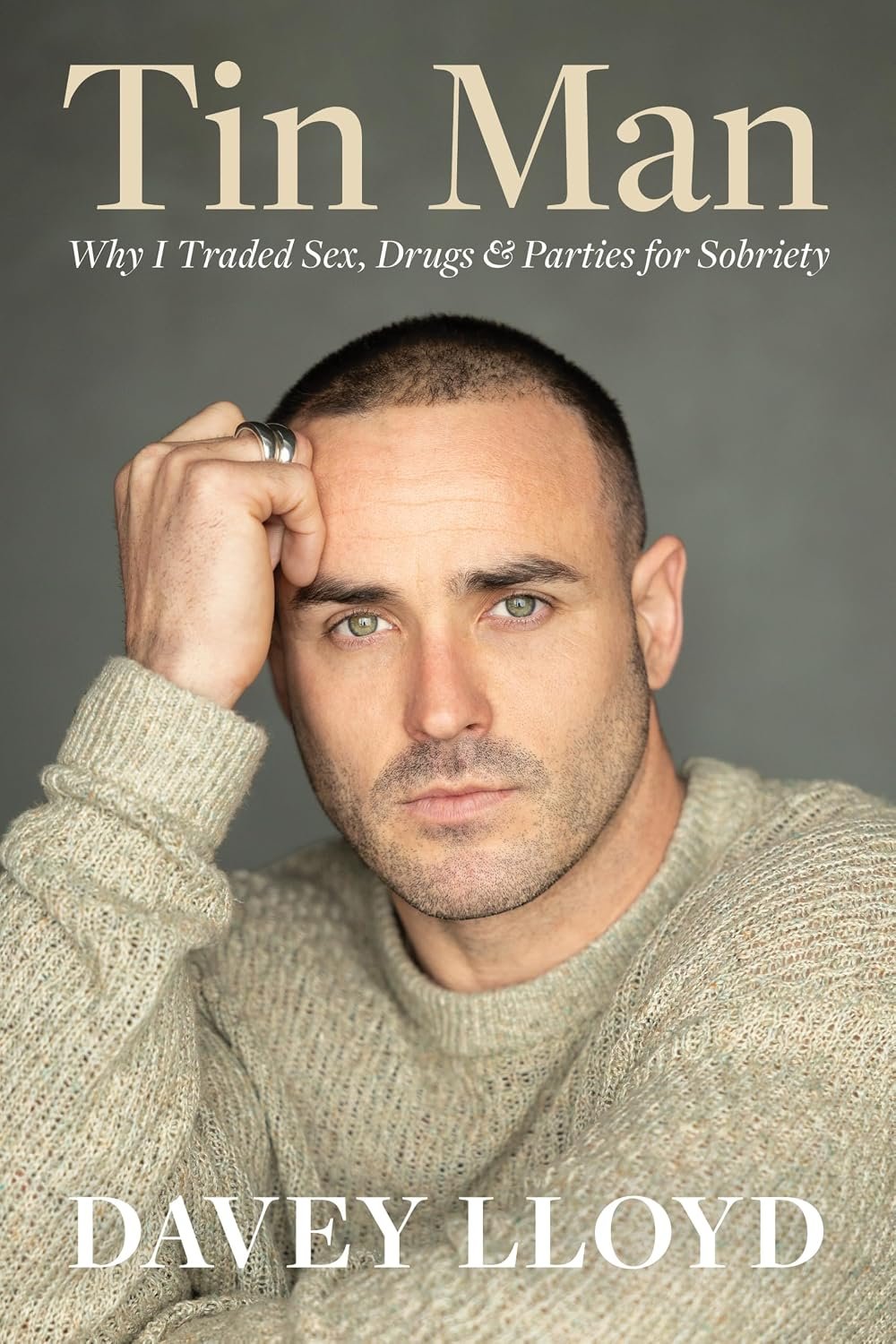
There comes a moment in Davey Lloyd’s Tin Man when the most important voice in his memoir is no longer his own. It comes relatively late, during his engagement with therapy, when his parents finally have the opportunity to explain what it has meant to love their son through years of addiction and recklessness.
For much of this memoir, Davey occupies almost every available space in the narrative. His drug-fuelled “benders”, sexual exploitation of women, bullying and casual disregard for those around him are described with candour. He makes no attempt to disguise the ugliness of what he has done, principally to those closest to him. Yet the narrative is so relentlessly self-absorbed that the people caught in his orbit rarely emerge as fully realised individuals. Their suffering is presented principally through Davey’s understanding of it. Then his parents speak and everything changes.
They have already suffered an unimaginable loss. Their infant son Adam, Davey’s older brother, died of SIDS. That grief forms part of the family’s shared emotional history, a tragedy all have struggled to properly process. But what becomes devastatingly apparent throughout the memoir is that Davey’s behaviour has forced his parents to live for years with the genuine prospect of losing another son. There is an unspoken scene that haunts them: a phone call in the middle of the night by some distraught friend or lover, telling them that Davey had not recovered from one of the at least three seizures he suffered.
For me, these are the most powerful passages in Tin Man. Davey’s parents finally get to explain what his behaviour has cost them. His journey towards sobriety is an admirable achievement, but it is their testimony that changes my understanding of the story. Until then, they have been characters in Davey’s orbit. Now he becomes a character in theirs.
Tin Man begins with a disturbing prologue describing an episode of drug-induced collapse. CPR, ambulances and hospitalisation are required. It is a chilling episode, establishing the extraordinary danger of the life Davey had been living.
Then, Davey gives an account of childhood, which introduces an important question: to what extent was his diagnosis of ADHD and subsequent prescription of Ritalin the entry path into his behavioural decline? Davey describes being an exuberant, disruptive child, more naughty than out-of-control. He tells of bullying other children, likely a consequence of being bullied himself. Both bullying, to and from, is peppered with physical violence. However, he specifically recalls the Ritalin as suppressing his natural curiosity and vitality. He is unable to compete in his beloved rugby league as effectively as he otherwise might. It is an important part of how he understands his early life. The question remains unanswered: he gives a tangential indictment of the pathologising of boyish exuberance by the school he attended, and the need to quickly medicate those who might overly disrupt the order of things. Nevertheless, we cannot mistake his personal experience for a general conclusion about ADHD treatment or its relationship with later addiction.
There is also a tension here that runs through the memoir. How does one reconcile the circumstances that contributed to destructive behaviour with the responsibility of the person who engaged in it? An explanation is not necessarily an excuse, but the distinction matters.
The book then adopts an unusual structure. Davey’s autobiographical account is interspersed with what amounts to a practical recovery programme. Chapters encourage the reader to admit the truth, abandon excuses, take responsibility and confront uncomfortable realities. There are even spaces in which readers can record their own reflections. At first, I found this somewhat presumptuous. Not every reader shares Davey’s addictions, nor has everyone engaged in conduct approaching the destructiveness he describes. The invitation to examine our own failings can seem to assume a common need for redemption.
But I can see another, more interesting reason for the exercises. Denial, rationalisation, avoidance and self-deception are not confined to substance dependence. They are recognisable tendencies in us all, although their consequences differ enormously. I also wonder whether the teaching of these steps is an integral part of his recovery, rather than simply advice he is offering the reader.
Reservations remain. One early passage illustrates Davey’s treatment of other children. Davey recalls approaching a woman he bullied at school, who was subsequently in a position to speak publicly about his behaviour during his television career. He describes apologising sincerely, her apparent acceptance of that apology, and the resulting interview being less damaging than it might otherwise have been. He is brutally frank about his former conduct, describing himself as a “cunt, plain and simple.” But I wanted to hear more about the encounter. What did he actually say? What did she tell him? What had his bullying meant to her? We learn that as a result of the apology, the consequences for him were less severe than they might have been. True that may be, but throughout the book, Davey recounts occasions when he was able to “sorry” his way out of scrapes. Yet the emotional life of the woman herself remains largely beyond our reach.
Elsewhere, Davey declares his shame and offers an unequivocal apology to those he hurt. I have no particular reason to doubt his sincerity. Indeed, his willingness to acknowledge his behaviour without dressing it up in euphemism is a key strength of the book. But confession and accountability are not quite the same thing, a distinction Davey acknowledges.
There are, of course, legitimate reasons for Davey not to retell private conversations or disclose the intimate suffering of others, perhaps without their permission first obtained. Their privacy is itself a form of agency. Davey also cannot invent their thoughts or manufacture conversations to satisfy our expectations. That would undermine the very authenticity that gives his writing its force. Nevertheless, he might sometimes have explored more deeply the limits of his own understanding, rather than allowing an expression of regret to bring an episode to its conclusion.
But as the memoir progresses, I began to reconsider this apparent weakness. For much of his life, Davey appears to have been incapable of seeing beyond himself. His writing reflects that limitation. Other people enter the narrative principally through the prism of his own experiences, his “benders”, then his guilt and then his attempts to make amends. But it is only through therapy and engagement with a life-coach that he begins to recognise their independent emotional lives. His parents’ testimony is especially moving because it forces him, and the reader, to confront suffering that his own narrative has largely kept at a distance. The movement from self-absorption towards genuine empathy is therefore not merely something Davey describes. It is something the reader experiences through the changing nature of the narrative itself.
Another late revelation is almost equally powerful. Davey discovers, apparently to his considerable disappointment, that he is not the empathetic person he imagined himself to be. For years, he has been surrounded by people prepared to love him despite his conduct. But receiving love is not the same as understanding the emotional experiences of those providing it. Nor does being forgiven necessarily mean one has developed the capacity to comprehend the injury requiring forgiveness. Sobriety and empathy are not interchangeable achievements. In that respect, the book resists the reassuring finality of absolution.
There are moments, particularly towards its conclusion, when Davey appears to approach the certainty of a man who has finally found himself. But the more compelling truth emerging from these pages is that sobriety, self-knowledge and empathy are not destinations reached simultaneously. The achievement of one does not guarantee the possession of the others.
Finally, there needs to be an acknowledgement of the quality of Davey’s writing. He possesses an extraordinarily assured literary voice. His prose is precise and remarkably persuasive. He has an instinct for modulation, moving between the abrasive vernacular of his former life and passages of genuine tenderness when describing the loss of his brother. His profanity is neither a hook nor a contrivance. It belongs to Davey’s voice, lending an intimacy and authenticity that less profane language might have diminished.
The result is an immensely readable book, capable of being read over a weekend but deserving of longer reflection. It would be a mistake to regard Tin Man merely as a celebrity confession, or to assume that the extremity of Davey’s experiences is sufficient to explain its appeal. He can write exceptionally well. I suspect that serious literary fiction is well within his capabilities.
Ultimately, Tin Man raises questions that extend well beyond addiction. What does it mean to take responsibility for the harm we have caused? Does genuine remorse require forgiveness? Can we ever fully understand the experiences of those we have hurt? And does the act of recovering from destructive behaviour confer any particular authority to instruct or preach to others?
Davey does not always answer these questions satisfactorily. Sometimes his narrative moves too quickly from wrongdoing to contrition. Sometimes the instructional passages risk simplifying experiences that deserve greater complexity. And sometimes the sheer force of his personality leaves too little room for anyone else. But those limitations do not diminish the achievement. In important respects, they help explain it.
Davey, like his memoir, remains a work in progress. For me, that is why the book deserves a readership far beyond those confronting addiction. The circumstances may be unfamiliar, but the discovery that we do not understand ourselves as well as we thought is not. Tin Man is not a perfect account of redemption, and it would be less convincing if it were. Its value lies in something more rewarding: the recognition that becoming a better person is not a single act of transformation, but an ongoing willingness to learn.
That makes it not simply a memoir worth reading, but a memoir worth thinking about long after the final page.